APRIL IS CHILD ABUSE AWARENESS MONTH

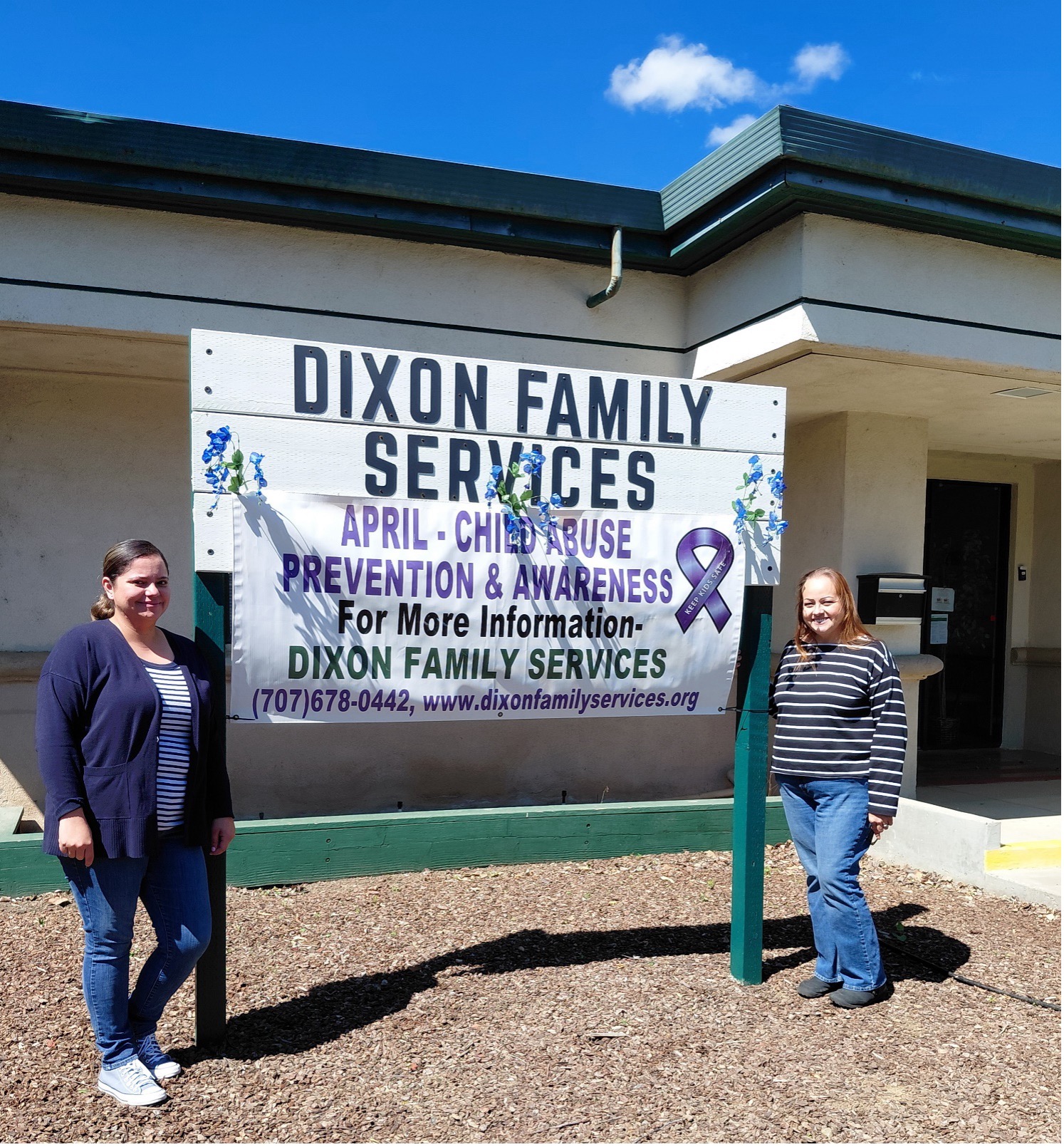
Dixon Family Services Case Manager, Sonia Santillan and Pantry Manager, Marisol Jimenez

Dixon Family Services (DFS) has a banner in front of the building during the month of April as one way to remind people that April is Child Abuse Awareness Month and that there are things we can all do to reduce and prevent child abuse and neglect.

Child abuse, in its many forms, happens every day and has major impacts on the futures of those victimized.  Solano County percentages are higher than California averages.

Studies show that there is a direct link between child abuse and a greater risk later in life of depression, alcoholism, drug abuse, smoking, eating disorders, obesity, sexual promiscuity, certain chronic diseases and suicide.

DFS does all it can to help ensure the safety and well-being of Dixon’s children all year long.  As a Family Resource Center, it is a priority goal to reduce the incidences of child abuse and/or neglect in homes and in the community at large by enlightening and informing people of the signs to watch out for, reporting suspected abuse, and steps to take to create an environment that can reduce the possibilities for abuse or neglect of children.

Though Dixon Family Services’ main focus is to assist households living at or below poverty, we want to be clear that child abuse knows no boundaries and is found in families of all socio-economic backgrounds and cuts across lines of ethnicity, culture, socioeconomic and education.

In 2025 Solano County Child Welfare Services investigated 172 child maltreatment allegations in Dixon.  This was an increase over 165 in 2024.

There are a number of factors that can create increased risk of child abuse including lack of parenting skills, teen pregnancy, substance abuse, mental illness, poverty and substandard housing conditions, domestic violence, and a parent history of child abuse.  These same risk factors can be barriers to abusers’ acknowledgement of the problem and ability to seek programs or services intended to stop the abuse such as parenting classes, counseling, peer support or other approaches.

As a community, we have a responsibility to nurture and protect our children, as well as other people’s children to ensure they can become healthy and productive adults.

Do not hesitate to report what you think might be abusive behavior to local police or county child protective services.  Let professionals determine if your concerns are worth investigation.

For more information about child abuse, ways to help prevent it, and how to report it, we suggest you visit our website, www.dixonfamilyservices.org,  the Children’s Network website www.childnet.org, the Partners in Prevention website www.partnersinprevention.org , or call Solano Child Welfare Services 800-544-8696 or your local police department to report.
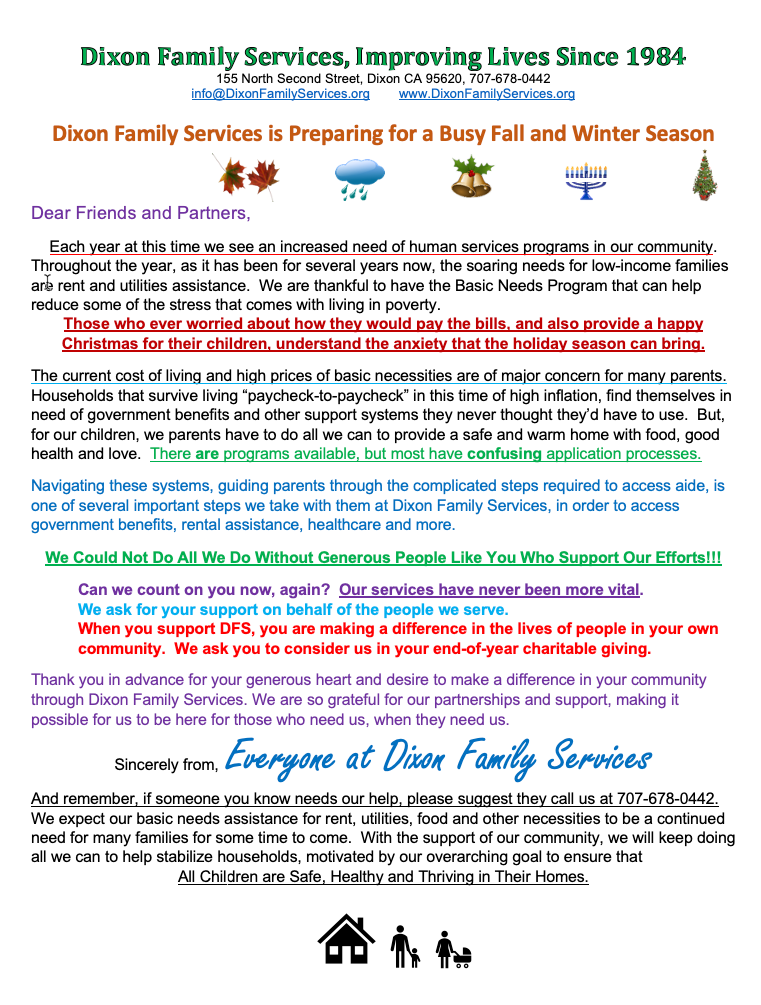
2025 Statememt about government shutdown

Dear Valued Community Member,

Thank you if you attended one of the Plan Bay Area 2050+ webinars last week.

Today we want to remind you there are still opportunities for anyone interested to participate in the processBeginning November 14 there will be 3 public hearings that you can choose to attend in person or via zoom.  Details and links to these meetings are in the information below from MTC/ABAG.

Public Hearings

Instructions to join by Zoom
Note: Meeting start time may vary.

  • Public Hearing #2 – Fremont
    Wednesday, December 3, 2025
    6 p.m.
    Olive Hyde Art Center and Gallery -or- Zoom
    123 Washington Boulevard, Fremont
    Zoom link: https://bit.ly/drafthearing2
    Webinar ID: 875 7625 3306
    Passcode: 178983
    888 788 0099 US Toll Free
  • Public Hearing #3 – Novato
    Thursday, December 4, 2025
    6 p.m.
    Novato Oaks Inn -or- Zoom
    Best Western Plus Novato Oaks Inn

215 Alameda del Prado, Novato
Zoom link: https://bit.ly/drafthearing3
Webinar ID: 898 0347 9624
888 788 0099 US Toll Free

released Draft Plan Bay Area 2050+ for review and comment.

the parallel Transit 2050+ planning effort

Read Draft Plan Bay Area 2050+ and the supplemental reports at planbayarea.org/draftplan

And you can submit written comments about the draft plan by December 18in the following ways:

  • Use the online comment form at org/draftplan
  • Email info@planbayarea.org (subject line: “Draft Plan”)
  • Mail in comments to:
    Metropolitan Transportation Commission
    Attn: Public Engagement
    375 Beale Street, Suite 800
    San Francisco, CA 94105

Leave a Voicemail

Call the Plan Bay Area public information line: (415) 778-2292

All comments must be received by 5 p.m. on Thurs., Dec. 18, 2025.


Subject: Draft Plan Bay Area 2050+ Is Here — Comment by December 18

Draft Plan Bay Area 2050+ Is Here

El borrador del Plan Bay Area 2050+ ya está disponible


Dixon Family Services (DFS) is partnering again with MTC/ABAG to get the word out about the draft plan for Plan Bay Area 2050, what it is, and the several opportunities for public input and participation.

View this information online in English
Ver la información en línea en español

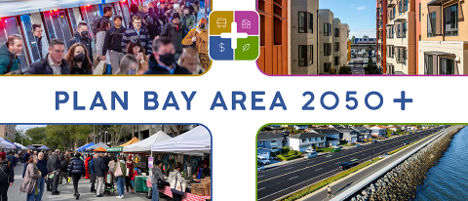
After more than two years of public discussion, technical analysis and refinement, the Metropolitan Transportation Commission (MTC) and Association of Bay Area Governments (ABAG) have released Draft Plan Bay Area 2050+ for review and comment. The plan contains 35 strategies representing public policies and investments that can be implemented in the Bay Area by 2050 to help the region build more homes, reduce commute times, and create vibrant downtowns and natural areas for everyone to enjoy. The plan’s strategies also aim to keep people safe from natural hazards, support a strong economy and provide stable housing for those who need it most.

Unique to this plan cycle is the parallel Transit 2050+ planning effort, which has culminated in the first-of-its-kind plan to re-envision the future of Bay Area public transit, in partnership with transit operators across the region.

The Draft Plan, along with the Draft Implementation Plan and various supplemental reports, are all available for review and comment.

Read Draft Plan Bay Area 2050+ and the supplemental reports at planbayarea.org/draftplan and submit your comments by December 18.

Opportunities to Participate

Webinars

Webinar ID: 892 3077 8001
Passcode: 256814
888-788-0099 US Toll Free

  • Webinar #2 – West Bay
    Wednesday, October 29, 2025
    6-7:30 p.m.
    Zoom link: https://bit.ly/westbaywebinar
    Webinar ID: 831 4140 5598
    Passcode: 096944
    888-788-0099 US Toll Free
  • Webinar #3 – South Bay
    Thursday, October 30, 2025
    6-7:30 p.m.
    Zoom link: https://bit.ly/southbaywebinar
    Webinar ID: 822 2561 7467
    Passcode: 356845
    888-788-0099 US Toll Free
  • Webinar #4 – East Bay
    Wednesday, November 5, 2025
    6-7:30 p.m.
    Zoom link: https://bit.ly/eastbaywebinar
    Webinar ID: 869 8283 4999
    Passcode: 682098
    888-788-0099 US Toll Free

Public Hearings

Instructions to join by Zoom
Note: Meeting start time may vary.

  • Public Hearing #2 – Fremont
    Wednesday, December 3, 2025
    6 p.m.
    Olive Hyde Art Center and Gallery -or- Zoom
    123 Washington Boulevard, Fremont
    Zoom link: https://bit.ly/drafthearing2
    Webinar ID: 875 7625 3306
    Passcode: 178983
    888 788 0099 US Toll Free
  • Public Hearing #3 – Novato
    Thursday, December 4, 2025
    6 p.m.
    Novato Oaks Inn -or- Zoom
    Best Western Plus Novato Oaks Inn

215 Alameda del Prado, Novato
Zoom link: https://bit.ly/drafthearing3
Webinar ID: 898 0347 9624
888 788 0099 US Toll Free

Written Comment

  • Use the online comment form at org/draftplan
  • Email info@planbayarea.org (subject line: “Draft Plan”)
  • Mail in comments to:
    Metropolitan Transportation Commission
    Attn: Public Engagement
    375 Beale Street, Suite 800
    San Francisco, CA 94105

Leave a Voicemail

Call the Plan Bay Area public information line: (415) 778-2292

All comments must be received by 5 p.m. on Thursday, December 18, 2025.